Hunger, thirst and chaos in southern Gaza as hostilities drive humanitarian aid to the brink of collapse
- account_circle investigasi
- calendar_month Kam, 8 Feb 2024
- visibility 509
Twelve-year-old Do’a Atef spends her days knocking on doors begging for food, or gathering firewood from a dusty hill near a refugee camp outside Rafah, in southern Gaza, to cook the few tomatoes and peppers given to her by strangers.
Do’a told NBC News that she was displaced from her home in Beit Lahia in northern Gaza, along with her parents and seven siblings, and they are now sleeping in tents. They are so thirsty, “we drink dirty water,” she said. “My siblings are crying all day.”
They couldn’t find flour, they were cold, there was no bathroom for them to use, no diapers for her baby brother, and no milk to give him. Two months ago, Do’a said, she used to read in school and play with her friends. “Now, all we do is bring firewood and walk barefoot.”
Do’a’s situation underscores a bleak reality for many in Gaza, as the Israeli military’s ground invasion and aerial bombardment continues, displacing an estimated 1.9 million Palestinians into shrinking “humanitarian zones,” mostly in southern Gaza. A dire food and water shortage is putting many at risk of infection and death, according to humanitarian aid groups that stressed difficulties in delivering aid due to the intensity of hostilities.
Israel continued to intensify its offensive in southern Gaza into Sunday.

“The scarcity of aid has led to desperate struggles over water tearing at our social fabric,” Bushra Khalidi, policy lead for Oxfam, said. “The situation in Gaza is not just a catastrophe, it’s apocalyptic.”
Aid agencies described children and families roaming the streets, unable to find food and with nowhere to go. Lines for clean water can last hours, and some have turned to collecting rainwater, which in this semi-arid land is scarce, too. Supermarket shelves are empty. People arrive at bakeries before dawn, with no guarantee they’ll end up with a sack of bread before the shop runs out.
The price for a 25-kilogram (55-pound) sack of flour has skyrocketed to as high as $100 — up from about $15 before the war.
“Numbers that are really, really beyond any capacity,” Najla Shawa, a Palestinian humanitarian aid worker who recently left Gaza, said of the soaring wartime prices. Other commodities and essentials, down to the containers Gazans use to collect water, she said, have also become perilously expensive.
“Even if you have the money,” Shawa said, “the trip to get it is very dangerous and it’s really difficult and humiliating.”
Shawa said the people she has spoken to in Gaza are rationing water. “They are really trying to consume very little,” she said. “A cup a day. A couple of cups a day for the adults, giving priority to children.”
Hazem Zarifa, a 24-year-old university student sheltering in the southern city of Khan Younis, said he has walked miles searching for a little bread or some canned food.
“I have so far lost more than 10 kilograms of weight” — about 20 pounds — Zarifa said. He felt sick from hunger.
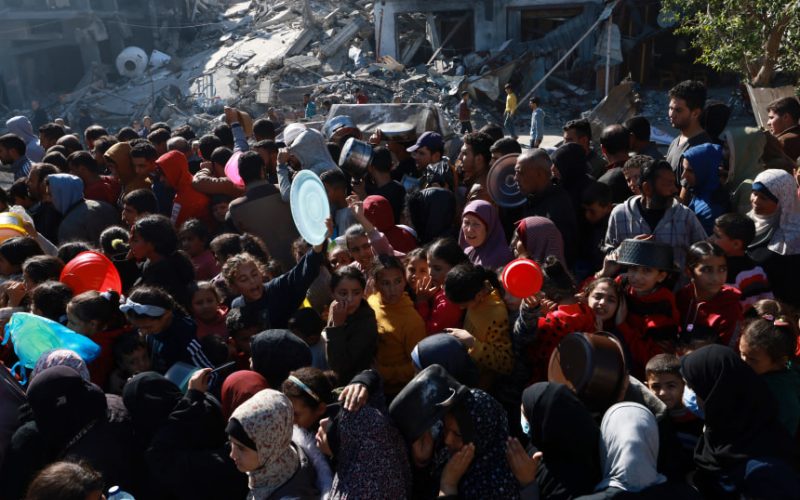
Palestinians line up for food donations in Rafah on Nov. 30. Conditions have worsened since. The U.N. secretary-general warned Thursday that the humanitarian support system in Gaza was at high risk of collapse: “We anticipate it will result in a complete breakdown of public order.”
Mohammed Abed
Representatives for several international humanitarian groups are struggling to describe the new lows after having spent much of the past two months of war ringing alarm bells about conditions on the ground in Gaza.
“Those who survived the bombardment now face imminent risk of dying of starvation and disease,” Alexandra Saieh of Save the Children said during a press briefing on Thursday.
“The lack of water and hygiene is aggravating the diseases: diarrhea, vomiting, skin allergy, lice in the children’s hair,” said Chiara Saccardi, regional head of Action Against Hunger.
During last month’s temporary pause in fighting, the World Food Programme conducted a rapid food assessment, which it released on Wednesday, concluding that the situation in Gaza was “alarming.”
In a statement issued after a visit to Gaza on Friday, WFP Deputy Executive Director Carl Skau said, “Gazans are simply not eating.”
He described “confusion at warehouses, distribution points with thousands of desperate hungry people, supermarkets with bare shelves, and overcrowded shelters with bursting bathrooms. The dull thud of bombs was the soundtrack for our day.”
Eighty-three percent of households in southern Gaza have inadequate food consumption, according to the report, with 38% suffering from “severe levels of hunger.”
In a press call with international journalists on Thursday, Oxfam’s Khalidi and others described the conditions in Gaza as “not survivable.”
“Oxfam categorically views these actions, including the use of starvation as a war weapon, massive civilian killings and collective punishment, as war crimes,” she said, referring to the Israeli-imposed siege that has cut off food, water, electricity and fuel since the war began.
On Thursday, U.N. Secretary-General António Guterres warned that the humanitarian support system in Gaza was at high risk of collapse: “We anticipate it will result in a complete breakdown of public order.”
In response, the Israeli military office that works in conjunction with the Palestinian territories said they are abiding by international law as they conduct their operations in Gaza. As it has done for weeks, Israel has blamed the humanitarian aid crisis on the United Nations Relief and Works Agency, the refugee wing dedicated to Palestinians. UNRWA has previously pushed back on that allegation.
- Penulis: investigasi